Northern Kentucky & Greater Cincinnati
Plantation Shutters
Timeless elegance. Lasting value.
Quick Answer
Timeless elegance in wood & composite — available from Hunter Douglas, Norman, Graber with free in-home consultation and professional installation in Northern Kentucky and Greater Cincinnati. Call (859) 446-8123 for a free quote.
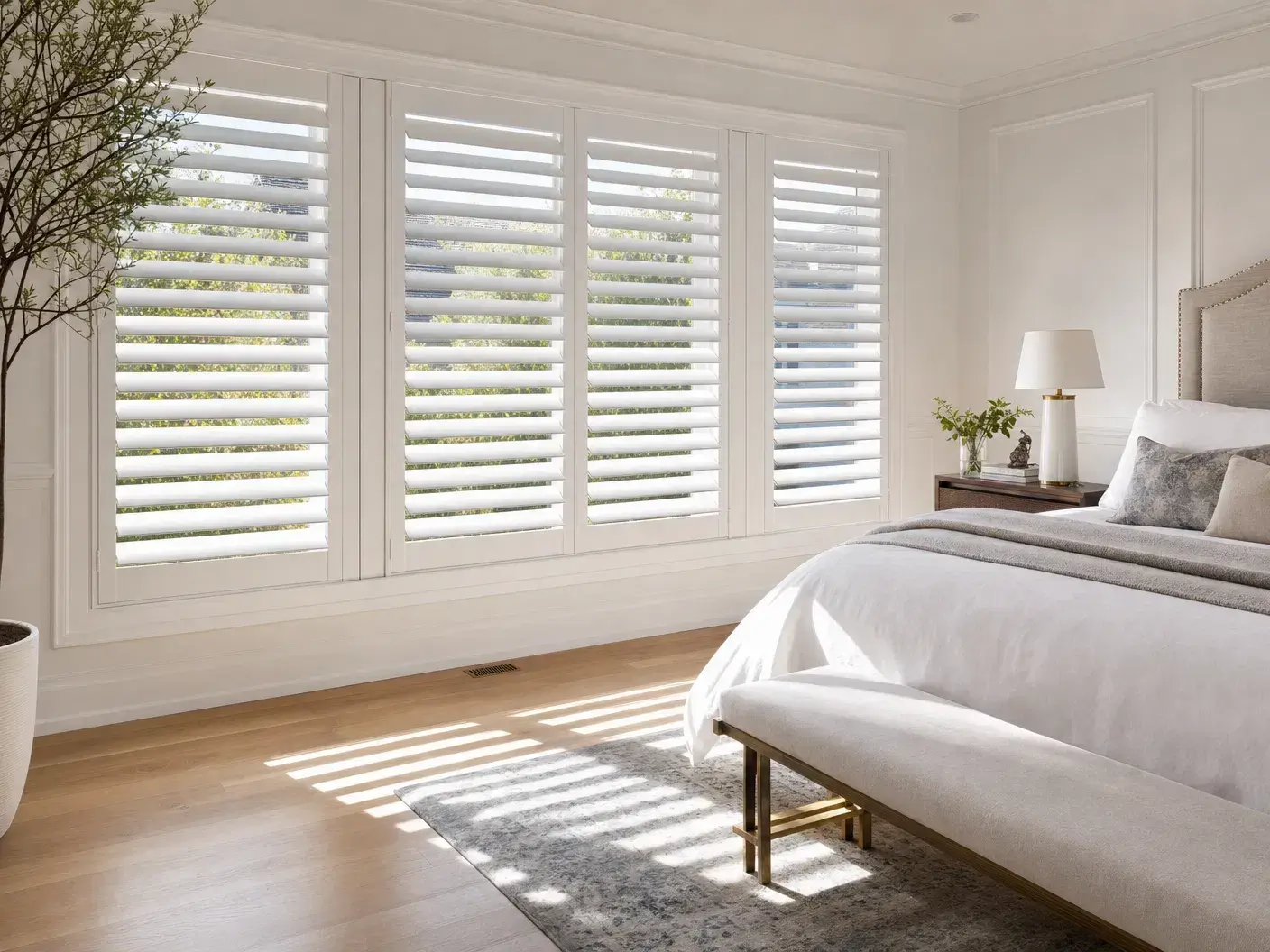
Plantation shutters are the gold standard of window treatments — timeless, durable, and endlessly versatile. Our custom shutters are available in real wood and moisture-resistant composite, offering superior light control and privacy while adding lasting value to your home.
Each shutter is custom-crafted to fit your exact window dimensions, with a variety of louver sizes, frame styles, and finishes to complement your home's architecture. Plantation shutters are one of the few window treatments that can actually increase your home's resale value.
What's Included
Key Features & Options
- Custom-crafted to fit any window size or shape
- Available in real wood and moisture-resistant composite
- Multiple louver sizes: 2.5", 3.5", and 4.5"
- Full-height, café-style, and tier-on-tier configurations
- Tilt-rod operation for a clean, uncluttered look
- Increases home resale value
- Easy to clean and maintain
- Professional installation included
Available From
Buying Guide
How to Choose Plantation Shutters
Plantation shutters are treated as a permanent part of the house, so they're worth choosing carefully. They can be built for almost any opening, from the tall, slightly out-of-square windows in older Cincinnati and Covington homes to the wide windows in a new build. These are the decisions that shape how your shutters look and work, in roughly the order we talk through them at a consultation.
Wood or composite
Real wood shutters are lighter than composite, which generally allows wider panels, and they can be painted or stained. They're the classic choice for living rooms, dining rooms and bedrooms, and a stained finish shows the grain in a way paint can't.
Composite shutters resist moisture, so they hold their shape in kitchens, bathrooms and laundry rooms, where wood can swell or warp over time. Many homes use both: wood in the main rooms and composite wherever there's water or steam. Once painted, the two are hard to tell apart from across the room, so the decision is mostly about where each shutter will live.
Louver size
Louvers are the horizontal slats, and we offer them in 2.5-inch, 3.5-inch and 4.5-inch sizes. Larger louvers mean fewer slats, so when they're open you get a wider view and more light. They suit big windows and more contemporary rooms. Smaller louvers have a more traditional look and are often better proportioned on small or narrow windows.
Check your window's depth, too. A larger louver needs more room to tilt without touching the glass, a window crank or a latch, and on shallow windows that clearance can decide the size for you. It's one of the things we measure at every window.
Full-height, café or tier-on-tier
A full-height shutter covers the whole window with one set of panels. Many include a divider rail across the middle, so the top and bottom louvers tilt separately: you can let light in above while keeping the view blocked below.
Café-style shutters cover only the lower part of the window. They give privacy at street level and leave the top open to the sky, which suits dining rooms and front rooms close to a sidewalk. Tier-on-tier shutters stack two independent sets of panels, so the top half can swing fully open while the bottom stays closed. That flexibility makes tier-on-tier a good match for tall windows in older homes.
How the panels open
Shutter panels are hinged, so they swing open like small doors to clear the window completely for cleaning or an unobstructed view. Before choosing, look at what sits in front of each window: a sofa, bed or dresser against the wall can stop panels from opening fully. On wide windows, panels can be hinged to each other so they fold back in pairs and take up less space when open.
Frames and fit
Shutters mount either inside the window opening or on a frame around it. An inside mount looks built-in and leaves your trim on show, but the opening needs enough depth to hold the frame and let the louvers tilt. An outside frame covers shallow or uneven openings, and can make a small window look larger.
Because every panel is made to your measurements, arched tops, angled windows and bay windows can all be fitted. That's also why the measuring visit matters. A shutter is built to the exact opening, so precise measurements are what make the panels close cleanly and the louvers line up from window to window.
Finish and color
White and off-white are popular because they match most window trim, but whites vary more than you'd expect. Compare samples against your trim in daylight rather than choosing from a screen or a photo. Stained wood suits rooms where you want to echo wood floors, cabinets or furniture.
If you're shuttering a whole house, one finish on every street-facing window keeps the outside looking consistent, even if the inside varies from room to room.
Light and privacy
Tilting the louvers gives you fine control. Tilt them so that, standing inside, you see sky through them: people at street level can't see in, and daylight still reaches the room. Set them level for light and view, or close them fully. Because there are no cords, shutters are easy to live with around children and pets.
Shutters block most light when closed, but thin lines of light can show between louvers and around the panels. If a bedroom needs to be properly dark, pair the shutters with blackout drapery, or use cellular shades in that room instead.
Compare cellular shades →Where shutters work best
Shutters are at their best in living rooms, dining rooms and bedrooms, and in bathrooms when you choose composite. They look just as tidy from the street as from inside, which matters on the front of a house.
They're less suited to openings where you want the glass completely clear most of the day, because open panels still sit beside the window. On very large glass doors and walls of windows, a shade or drapery that stacks away may be the better choice, and we'll say so at the consultation.
Cleaning and care
Shutters are one of the easiest window treatments to keep clean: dust the louvers with a soft cloth or duster, and wipe them with a damp cloth when needed. Composite can take a wetter wipe than wood. Swing the panels open now and then to clean the glass and sill behind them, which is much easier than with a fixed shade. If something stops working later, such as a loose hinge or louvers that won't hold their angle, our repair team can diagnose and fix most problems, and can often source replacement parts.
Repair and maintenance →Questions to think about before your consultation
A few questions make the consultation quicker and the result better. Which rooms need privacy at night, and which only need glare control during the day? Is there a window where you'd like the top open and the bottom closed, which points to tier-on-tier? Are any windows in steamy rooms, where composite makes sense? And is anything in front of the windows, like a bed, a sofa or a radiator, that the panels need to clear when they swing open? Jot the answers down as you walk through the house, and we'll work through them window by window.
What to expect
At your free in-home consultation we bring samples, measure each window precisely, and give you a detailed quote, with no obligation. Shutters are built to order, which typically takes four to six weeks, and installation in a standard home usually takes two to four hours. Before we leave, we'll show you how to operate and care for everything.
How a free consultation works →Serving Greater Cincinnati and Northern Kentucky
We measure and install across Greater Cincinnati, including Hyde Park, Oakley, Mariemont, Madeira and Montgomery, and throughout Northern Kentucky from our showroom in Florence. Consultations are free, and we bring the samples to your home so you can judge colors and fabrics in your own light.
Window treatments in Cincinnati →Free Consultation
Ready to get started?
We offer free in-home consultations throughout Northern Kentucky and Greater Cincinnati.
REQUEST A FREE QUOTE (859) 446-8123Free In-Home Consultation
Get a Quote for Plantation Shutters
By submitting, you consent to receive SMS messages and calls from A Shade Above. Msg & data rates may apply. Reply STOP to opt out. Privacy Policy.
Frequently Asked Questions
Plantation Shutters — Common Questions
How do I get a quote for plantation shutters in Northern Kentucky?+
A Shade Above provides free in-home consultations throughout Northern Kentucky and Greater Cincinnati. During your consultation, we measure your windows, discuss material options (wood vs. composite), louver sizes, and configuration, then provide an exact quote tailored to your home. Call (859) 446-8123 to schedule.
What is the difference between wood and composite plantation shutters?+
Real wood shutters offer authentic warmth and are ideal for living rooms and bedrooms. Composite (faux wood) shutters are moisture-resistant, making them the better choice for kitchens, bathrooms, and humid spaces. Both are custom-crafted and professionally installed.
How long does plantation shutter installation take?+
Most plantation shutter installations in the Florence, KY area are completed in 2–4 hours for a standard home. Lead time from order to installation is typically 4–6 weeks, as each shutter is custom-fabricated to your exact window dimensions.
Do plantation shutters increase home value?+
Yes. Plantation shutters are one of the few window treatments that can increase your home's resale value. They are considered a permanent fixture and are often highlighted in real estate listings as a premium feature.